Metamodernism & Metaphilosophy:
Descartes once wrote “Dubito, ergo cogito, ergo sum” which translates to “I doubt, therefore I think, therefore I am.” The former part is often forgotten. At our essence, what we commonly experience as our existence begins in doubting the nature of that existence and our larger reality itself. I once heard it put another way by a hiker in Colorado: “adventure begins when something goes wrong.” Otherwise we experience life within a state of flow within a collected awareness composed of layers, moving from one daily ritual to the next, and completing tasks according to the heuristics we have acquired and the mental schemas we have developed to deal with them. When we doubt some aspect of how we do this, or an obstacle presents itself that we aren’t automatically equipped to cope with, we stop and contemplate it as novel emotions arise out of our human concern whether the reaction is positive, negative, or neutral.
This process, to the frequency that it occurs, comprises our mental life; the momentary worlds we construct through the stories we tell to ourselves in the liminal spaces between carrying out our daily rituals. Conversely, I argue that the more we manage to systemize, polish, and ritualize our daily interactions with the world the more we are able to transcend the individual ego by living in a state of flow with reality’s natural processions and endowing them with constructive meaning, no matter how banal or ordinary. No matter how undesirable one’s outer life can be, one can still manage to harbor a rich interior life. This allows for true leisure outside of our contemporary world of distracted leisure, where we can be affordance-responsive to deep existential reflection that is the mark of true philosophical enquiry. This as opposed to “acedia”, or the mindless jumping from one stimuli to the next in pathological demand avoidance to retain an illusion of control over our diminished personal time and achievement-driven life efforts that cause us self-imposed stress.
I experience these modes of being regularly in my own daily life. The Orthodox Church Father St. Basil the Great once wrote “This is how you pray continually – not by offering prayer in words, but by joining yourself to God through your whole way of life, so that your life becomes one continuous and uninterrupted prayer.” As a Greek Orthodox Christian, a life of Eudaimonia, or human flourishing, means a life of not only verbal prayer, or passive understanding of scripture, but cultivating a Bios, Greek for “way of life”, oriented towards The Holy Trinity by being mindful of God’s presence in every action from eating, to drinking, to dressing, to working, to sleeping. Through virtuous actions, such as gratitude, generosity, and kindness in line with the core commandments given by Jesus Christ to love God and to love my neighbor as myself, I am entrained into an attitude or disposition of Phronema, or the “Orthodox Mind”, where God is a constant companion. Life’s events can then be viewed through the cognitive lens of a life-long dialogue between God and myself, through the medium of reality, in dialogical reciprocity, redamancy, and personal redemption. In this way I am able to strive to be in the World but not of it. To be sincerely engaged in life’s events and earnest in my relationships with others while not being utterly dependent on them for my life’s ultimate meaning. It is both a personal relationship reinforced by a community with a common spiritual framework. My personal faith and doubt walks hand in hand through moments of both flow and hesitation.
The utility of Education isn’t about what you know, but who you are equipped to become after being educated. Not about what information you possess at your disposal, but how it is instantiated in your personally chosen way of life. This makes it as much of a spiritual matter as a mental one. It is important to hold the cognitive capacity to critically arrive at conclusions or disentangle fallacious or deceptive positions, but it is also important to develop the mental infrastructure, let’s call it “psychitecture”, that directs our thoughts towards a larger vision of human flourishing for our life. The distinction between divergent and convergent modes of thinking comes to mind.
Our mind can be in a state of exploring a wide range of possibilities and solutions to a problem. Examples of this include brainstorming sessions at work. This divergent mode of thought is characterized by it spontaneous, free-flowing, non-linear emphasis on creativity and imagination in order to encourage growth in the idea pool, strategic innovation, and identification of novel approaches. Our mind can also be in a state of narrowing down options and selecting the best solution to an issue of concern from a finite set of possibilities. Examples of this include answering a multiple-choice question, solving an equation, or making a business decision based on data analytics. This convergent mode of thought is characterized by its analytical, logical, fact-based emphasis on efficiency and practicality in order to encourage finding the most effective and correct solutions, optimizing available options, and making decisions based on logic and evidence. Here is a short video on how a yoga instructor applies these to the topic of business innovation:
The mark of being highly educated is an ability to exercise control and appropriate application of these two modes of thinking to realize one’s life projects. It isn’t mere readiness for work, but the cultivation of the moral and intellectual virtues that free one’s mind from limitation by the brute facts of one’s life position.
We can call this generally somatic freedom: “The ability to adapt responsibly, and respond creatively to one’s environment.” That is the original manifestation practice: the art of making appropriate relationships to things and persons in the world in order to persist through the accommodation and improvement of our environment. It is about spiritual fitness first, not mental fitness. Not about intellectual force, but the integrity and coherence of leverage-able mental structure. You don’t overcome the world by dominating maximal material portions of it, but by optimally living in your designated creative space while making the world a better place. We jointly participate in the fashioning of our common chapter in history through communion with one another.
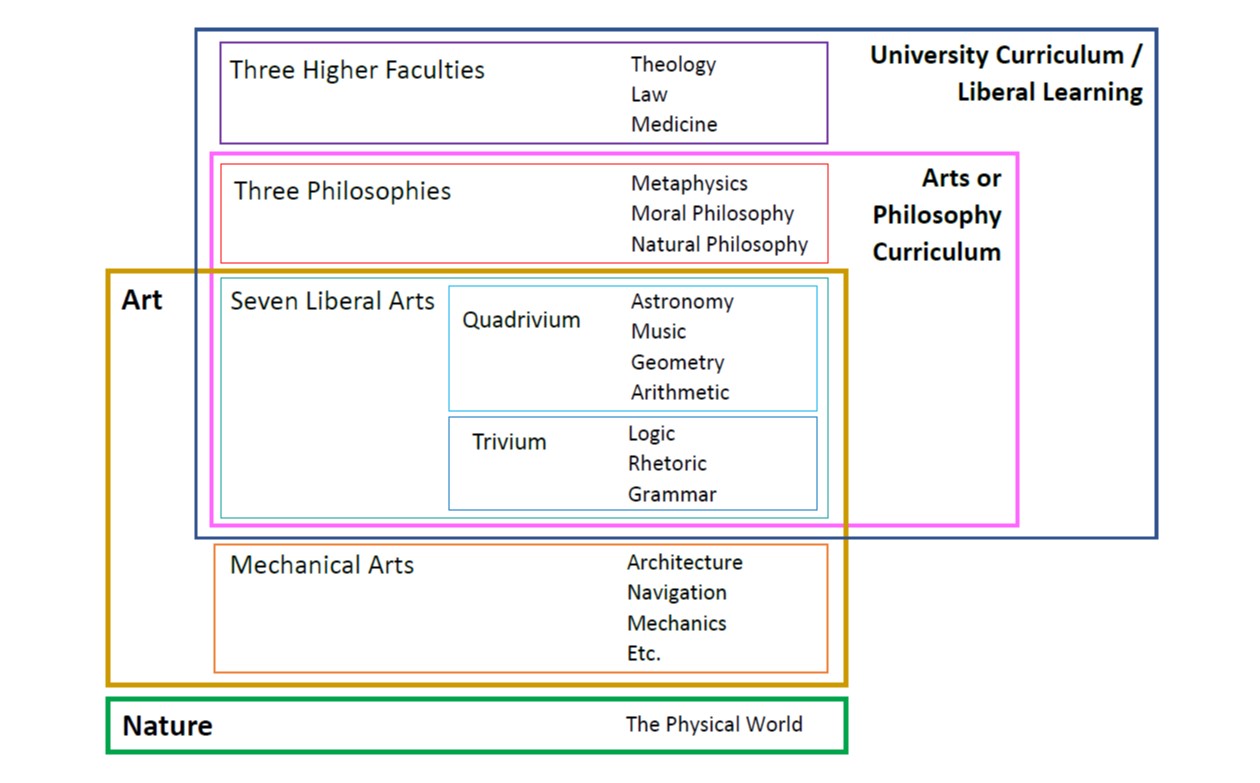
To equip the individual soul for life’s calling, The Middle Ages conceived of an educational model consisting of 3 humanities and 4 sciences. As opposed to being mere subjects in and of themselves, they were viewed as “modes of learning”. They were the sorts of material studied by free individuals on a journey to liberate their minds from life’s perceived limitations of their time. This was opposed to the strictly practical education of the peasant class in skills like cooking, agriculture, or toolmaking. This was knowledge meant to transform them personally. For example, music was not studied for its practicality to society, but for its effects on purifying the soul through the study of harmonies and the nature of the relationship between sound and silence. The humanities were referred to as “The Trivium” intended to produce competency in language since all knowledge is conveyed through it.
- The Trivium:
- Grammar= Taught the mechanics of language comprehension and skill at conveying complex ideas through the reading of great works from history, such as Homer’s Odyssey.
- Dialectic (Logic)= Taught the anatomy of thought and skill in composing sound arguments while identifying wrong ones. You’d study Porphyry’s Introduction to Aristotle’s work on logic.
- Rhetoric= Taught the use of language to instruct or persuade. Knowledge transmitted through grammar, and understood through logic, could then be passed on as wisdom. You’d likely study Cicero’s “De Orate” as a core text.
The Sciences were referred to as “The Quadrivium” intended to instruct a student in the foundational contention of ancient thinking that the Universe is bound by a mathematical harmony that emanates patterns of visible phenomena.
- The Quadrivium:
- Arithmetic (Example: Fibonacci’s works on Hindu-Arabic numerals)
- Geometry (Example: Study of Euclid’s Elements)
- Music (Example: Study of Boethius’s De Musica)
- Astronomy (Example: Study of Plato’s Timaeus)
After completion of the 7 Liberal Arts, the culmination of a complete Christian education was introduction of the mind to philosophy, law, medicine, and theology. The nested nature of this educational model is provided here:
We now have a diverse range of specialized and interdisciplinary areas of academic study in our digital society. In order to keep salient the need to engage in these more modern fields of intellectual inquiry, consider this hypothetical reductionist conception of what we refer to as the “STEM” fields inspired by process philosophy:
The Wheel of Intellectual Inquiry:
- Philosophy = Applied Sociology
- Philosophy arises from the qualia of human life, rooted in the current understanding of a time and place, and the questions about it in the context of human natures relating to other human natures in the world. Abstracted, we refer to this field today as sociology.
- Sociology = Applied Psychology
- Sociology arises from studies into the workings of individual human minds which are later grouped back with other human minds. Abstracted, we call this compendium of insights the field of psychology.
- Psychology = Applied Biology
- Psychology arises from investigations into the processes of living bodies that support the possibility of mental life, sometimes viewing the latter as an emergent property of the former. This field is referred to as biological science.
- Biology = Applied Chemistry
- Biology arises from experiments that peer into the unseen world of molecular and atomic structures and their reactions that serve as the foundation for biological processes. This is the study of chemistry.
- Chemistry = Applied Physics & Engineering
- Chemistry arises from methodological advances and paradigm shifts in predicting the regularly observed material phenomena of the world, as well as devices that allow us to organize and manipulate that material. It is achieved through the careful distillation and scientific testing of principles, heuristics, and models of the Universe in part or in total. Depending on whether the philosophical product is intellectual or physical, we call this study physics or engineering.
- Physics & Engineering = Applied Mathematics & Computer Science
- Physics and engineering is built upon the axiom that mathematics reveals principles that describe the reality we live in whether past, present, or future. The tools and methodologies developed in math and computer science are the platform upon which physics and engineering builds its projects.
- Mathematics & Computer Science = Applied Philosophy
- Mathematics and computer science aims its goals towards better understanding of the human place in the Universe and what it can achieve through technological know-how. Here we arrive again at the starting point of philosophy, but in applied form. It is taking well-articulated philosophical matters of human concern in society, systemizing them, and designing tools to more easily and efficiently describe and cope with them.
Therefore, I can view philosophical inquiry as a cyclic process moving from doubt, hesitation, or awe about some aspect of the human experience that comprises the philosophical literature at a time and place in history. Once systemized and abstracted it becomes the field of sociology, which is further abstracted into personal psychology, etcetera, and ends in theoretical knowledge (Greek: “episteme”) or technology (Greek: “techne”) that helps us cope with some aspect of human experience. Once this knowledge or technology becomes obsolete in the face of new human needs and challenges, it inspires further philosophical doubt, hesitation, and awe at new possibilities, which reignites the process. This also displays a gradual move from a generalist scope of knowledge in philosophy and the social sciences to specialization in the hard sciences bridged by biology and chemistry. I use this thought experiment as a map when searching for inspiration in novel subcultures to help me relate the work of other generalists or specialists to my own domain of massage therapy. At the same time, each field contains its own distinct subject matter with its own accepted methodologies. Let us for a moment consider the topic of methodology as pertaining to the field of philosophy.
The Philosophical Method encompasses the various approaches philosophers use to investigate fundamental questions about reality, knowledge, and values. It involves critical thinking, reasoning, argumentation, and often employs thought experiments, conceptual analysis, and dialogue to explore different perspectives and refine personal understanding.
A Philosophical Method.
- Questioning and Problem Identification.
- Philosophy often begins with a question or a problem that challenges our assumptions or current understanding of the world.
- These can be about anything from the nature of reality and knowledge to morality, ethics, and the meaning of life.
- Conceptual Analysis.
- Philosophers analyze the meanings of concepts to clarify their usage and implications. For example, “what does it mean to be just, free, or conscious?”
- This involves examining definitions, identifying necessary and sufficient conditions, and exploring how concepts relate to each other.
- Argumentation.
- Constructing arguments in support of claims and critically examining and evaluating arguments of others.
- Arguments can be deductive (drawing logically certain conclusions from premises), Inductive (drawing probably conclusions from evidence), or Abductive (inferring the best explanation).
- Thought Experiments.
- Thought experiments are hypothetical scenarios used to explore implications of a concept or theory through stress testing it against plausible objections.
- They can help reveal inconsistencies or offer insights into the nature of reality. For example, the “Brain in a vat” thought experiment explores the nature of reality and our knowledge of it.
- Examining Assumptions.
- Philosophers critically examine the assumptions that underlie our beliefs and arguments.
- This involves identifying hidden or implicit assumptions and evaluating their validity.
- Dialogue and Debate.
- Philosophical enquiry often involves engaging in dialogue and debate with others. This can lead to a more nuanced understanding of an issue and help identify weaknesses in one’s own position.
- The Socratic method, for instance, involves a back-and-forth questioning to challenge assumptions and clarify understanding.
- Seeking coherence and consistency.
- Philosophers strive for consistency and coherence in their beliefs and arguments.
- This involves evaluating the implications of different beliefs and making sure they fit together logically.
- Applying logic and reasoning.
- Logic and reasoning are fundamental tools in philosophy. Philosophers use logical principles to analyze arguments, identify fallacies, and construct sound arguments.
- Considering different perspectives.
- Philosophy encourages considering different perspectives and viewpoints. This helps to avoid biases and broaden understanding.
- Making “progress”.
- While philosophy may not always offer definitive answers, it can make its own form of progress by clarifying concepts, identifying novel problems, and refining established arguments.
- Through consistent practice, it can help us better understand our own beliefs and values.
A Brief Intro to Bios Templates: A Metamodernist Tool.
In digital society, everyone to some extent lives within their own echo chamber of online content. In dialogue with others, the experience can often feel as though you are entering a foreign world that you have to strive to navigate and understand as you feel out how different it is from your own. I contend technology is merely a magnifying glass of a deeper reality about human beings: that we are more properly conceived of as ecosystems for growing possible worlds. We consist of events of interdependent phenomena patterns nested within the layers of our mental awareness, the integrated subsystems of our physical body, and the cognitive thresholds that regulate us spiritually. Every person is the axis Mundi of a finite, unique perspective experiencing an infinite Universe. We are possibility nested within necessity; an inward infinity, dialoging with an outward infinite, mediated by the finite threshold of our physical existence.
As a tool to navigate this terrain I have developed a heuristic for modeling two persons as possible worlds to ease the process of crossing over the cognitive thresholds of these theoretical worlds and relating them to one’s own. They are based in the notion that each person’s perspective, which is the possible world they are host to, exists within a story or metanarrative about the actual world. I think of it as being to philosophy what “Feynman diagrams” are to theoretical physics. As the diagrams help physicists bypass lengthy calculations to arrive at complex solutions to subatomic particle interactions, a bios template is a cognitive lens through which a philosopher can quickly engage in world-building and intuitively focus in on salient areas of investigation and argumentation as it relates to a dialogue with another subject. They have also proven to be an excellent meditation tool for phenomenological interviews for journaling purposes. They take the following form:
- P: Metaphysics. Satisfies “Where?”
- L: Epistemology (method of inquiry). Satisfies “How?”
- E: Ethics (moral frameworks). Satisfies “What?”
- O: Ontology (subcultures). Satisfies “When?”
- Sc: Self-Concepts & Roles. Satisfies “Who?”
- A: Organizing Principle (propositional attitudes). Satisfies “Why?”
Here is an example of a Bios Template I am currently exploring to more rigorously define a uniquely American Existentialism=
- P: Love (of common interests & ways of living)
- L: Truth (through dynamic oscillation between conscious faith & doubt)
- E: Heroism (for community welfare)
- O: Self-Sustainability (as Minimalist Solar Punk)
- Sc: Pragmatic Optimism
- A: Recursive Self-Transcendence through Iterative Self-Reflection
And here is an example of a Bios Template I have made to characterize the “Burnout Society”of Neoliberal Psychopolitics coined and articulated by Byung-Chul Han that I made reference to in my prior post=
- P: Nominalism, or a focus on particulars (vs Platonism, or a focus on universals)
- L: Excessive Skepticism (vs Collective faith in others)
- E: Moral Relativism (vs Moral Realism)
- O: Cyber Punk, or techno-pessimism (vs Solar Punk, or techno-optimism)
- Sc: Postmodern Ironic Cynicism (vs Metamodern Sincerity)
- A: Self-Actualization (vs Dialogical Reciprocity & Redamancy)
I invite you to read the description defining what each part of a Bios Template means, then turn your attention to one of the other templates provided. Try to see how the different concepts begin to paint a picture of a certain way of existing in the world. What sorts of thoughts does it inspire? What do you like about this possible world? What do you dislike? Is it readily obvious to you why? How would you describe the possible world that exists within the unique ecosystem of your own awareness?
In summary, Bios template uses include:
- Meditating upon templates related to an internal dialogue with the self.
- Meditating upon templates related to an external dialogue with individuals or groups.
- Meditating upon templates related to a cultural dialogue abstracted.
- An aid for Transcript Analysis & Textual Exegesis.
In conclusion, the way of doing philosophy that I am currently interested in doing is the culmination of trying to reconcile key distinctions from metaphilosophy that I first encountered in my senior philosophy seminar at Bowling Green State University. The first was the distinction between Analytic and Continental philosophy, which continues to become increasingly irrelevant in contemporary philosophy. Nevertheless, it is a noteworthy point of discussion within the history of philosophy. It denotes a noticeable different in approach and methodology between the Analytic philosophy style of the UK and USA and those of Eastern Europe in places like France or Germany. The former emphasized the logical analysis of linguistic concepts on highly limited scopes of subject matter following the linguistic turn of 20th century philosophy initiated by Austrian philosopher Ludwig Wittgenstein. The latter expressed more concern for cultural issues, social systems thinking, and the precise and personal description of conscious human experience through methods like Edmund Husserl’s Phenomenology.
I found potential reconciliation of these viewpoints in the Experimental Philosophy, or “X-phi” school of thought pioneered by Princeton philosopher Joshua Knobe. It is a relatively new field of philosophy that utilizes empirical methods, particularly those from psychology and cognitive science, to investigate philosophical questions. It aims to move beyond traditional philosophical methods, such as thought experiments, by gathering data on how people actually think and make judgements about philosophical concepts. This involves both the clarification of linguistic concepts as well as effective vehicles of description for human experience.
Preparing to graduate, in true philosophy student fashion, I had also begun to contemplate the meaning of my degree in philosophy. This led me to question the distinction between pure and applied philosophy. My plan at the time was to pursue my Ph.D in philosophy and BGSU has an excellent doctoral program for applied philosophy so I felt it was important to think through that transition if all went according to plan. I didn’t receive a clear answer until years later after I had left massage therapy school when I encountered the work of Pierre Hadot and his conception of Philosophy as a Way of Life, and not a possessed theoretical framework. It sparked an interest in Metaphilosophy where I began to realize that many theoretical or “pure” approaches to philosophical problems have effective applications to applied domains if the concepts can be effectively translated from one domain of expertise to another.
Around the same time was my aforementioned growing interest in the Artisan Economy and trades requiring “skillful know-how” that affords the disclosure of worlds through human participation in possibility. This interest also blurred the line between properly Academic and merely Public philosophy. This was in virtue of the fact that the artisans were describing heuristics and best practices, as well as entrepreneurial life philosophy along the way through online snapshots into their way of life.
They utilized a ritual epistemology, the notion that meaning is obtained through shared, ritualized, communal experience and not the mere accumulation of accepted facts about reality. It concerned human qualia, the “what-it-is-likeness” to be a certain kind of being in the world. I refer to the plethora of content like this that drew my attention as the “Phi-G phenomenon”, a growing population of online content creators rooted in a way of life with a sharable philosophy. I contend that the real-world insights, examples, heuristics, and messages of everyday people will over the long-term prove just as valuable to the history of philosophical literature as published essays in academic journals where they manage to be well-articulated and relatable to the average person.
After encountering metamodernism, over the last 3 years I have been focusing on the distinction between critical and creative philosophy as it relates to issues of Metaphilosophy and Philosophy Education. Compare this to the distinction between Literary Criticism and Creative Writing. In “Lit Crit”, written or spoken texts are analyzed and systemically evaluated. In creative writing, a student works to discover their own literary voice, attitude, style, phrasing, subject matter, and processes of outlining and composition by drawing inspiration from writers that they appreciate already. I am interested if this approach would be effective in public philosophy education as well. As a neophyte becomes proficient in the philosophical method, they ought to also experiment with conceptions of human flourishing suitable to them while discovering their own philosophical voice, attitude, style, phrasing, subject matter, and processes for outlining theoretical frameworks and polishing philosophical compositions. This area would be more dependent on collaboration than critical dialogue and debate with others. It would also require an investigation of the nature of inspiration, which is what drove me to the Inspiration Economy as a project. I wish to encourage this concept of Creative Philosophy in the short term, while others cultivate proficiency in Philosophy Criticism in the long term as their fondness for the subject deepens organically.
The philosophical product of such a Creative Philosophy curriculum wouldn’t be repetitious production of essays comprised of analyses of established works of academic philosophy. It would instead be compendiums of journal entries, notes, dialogue transcripts, and multimedia content that represent the process of someone articulating a Way of Life for themselves. A historical example of this is the Meditations of stoic philosopher Marcus Aurelius. His work was not a systemized theory but a collection of reflections on the emperor he was striving to become. It is work to return to and reread to reflect upon its personal insights as a monk would recite a mantra in service of his spiritual goals. My hope is to provide portraits of such content from social media events of potential internet philosophy from a place and time in culture.
In my own process, my meditation literature often moves from a poetic voice, to a narrative voice, to philosophical prose. First it is highly intuitive and imprecise as well as full of colorful language and rich in metaphor. Over time this organizes itself into a discernible story of mental events that I can begin to outline. I then end at using the narrative outline I’ve constructed to crystallize essential points to fill in as content. Cyclically moving from inspiration, to form, to content.
As I deepen this practice, I define a well-articulated Bios for personal flourishing, the magnum opus of the philosopher, as satisfying the following criteria:
- A general conception of ultimate reality & an interior world that mirrors it.
- A coherent method of inquiry & evolving approaches to constructing meaning from experience.
- A consistent attitude towards existence & practice(s) for cultivating virtue.
In my next post I will introduce my version of a Bios so far, modeled in the form of an instructive program for others to experiment with. I refer to this as my “ESP” program, or “Experimental Somatic Philosophy” program that describes a basic “what-it-is-likeness” to live my life as a somatic philosopher, leisure designer, and massage therapy entrepreneur.
 The Inspiration Economy.
Leave a comment